
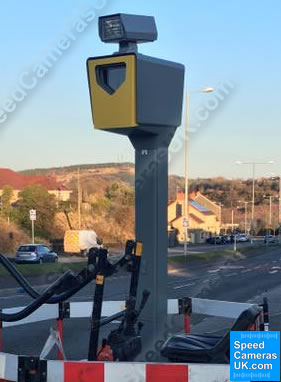
 Redflex Traffic Systems is an Australian traffic enforcement company with UK offices in Southampton. Its speed and red light enforcement systems are Home Office Type Approved for use on UK roads and come in three main variants: REDFLEXred for junction enforcement, REDFLEXspeed for motorway and major road speed enforcement, and REDFLEXred-speed which combines both functions.
Redflex cameras are not common on UK roads as standalone installations, and only 1 location in our database is specifically recorded as a Redflex camera. However, Redflex is far more prevalent than that number suggests - the company also manufactures HADECS 3, the smart motorway variable speed camera now deployed across the UK's managed motorway network, and REDFLEXred junction cameras which may be recorded in our database as traffic light cameras.
Technically Redflex uses dual radar technology with an 11-megapixel digital camera and can enforce up to six lanes simultaneously. Its systems can capture multiple offending vehicles at the same time and are capable of monitoring both speed and red light compliance from a single installation.
REDFLEXred and REDFLEXspeed: what is the difference?
Redflex produces three distinct enforcement systems for the UK market, each Home Office Type Approved for its specific enforcement purpose.
REDFLEXred is a junction enforcement camera designed to catch vehicles running red lights and vehicles speeding through green lights at signalised road junctions. It is forward-facing, meaning it photographs the front of the offending vehicle - capturing the driver's face and the front number plate. Loop detectors embedded in the road surface at the stop line trigger the camera when a vehicle crosses on red or exceeds the speed limit through the junction. A single installation can cover multiple lanes at the same junction.
REDFLEXspeed is a dedicated speed enforcement camera for motorways and major roads. It is typically mounted on overhead gantries or roadside poles and can monitor up to six lanes of traffic simultaneously from a single unit. It uses dual radar technology to provide independent speed measurements for each detected vehicle and can accurately assign each offence to the correct lane. REDFLEXspeed is also available in a mobile configuration, mountable in a vehicle to allow enforcement from a moving or parked position.
REDFLEXred-speed combines both functions in a single unit, allowing one installation to enforce both red light compliance and speed limits simultaneously. Home Office Type Approval for these systems covers single offences only. Where a driver crosses a red light while also speeding, police have discretion over whether to prosecute the speed element separately in addition to the red light offence. Speeding through a green light at a REDFLEXred junction is also a prosecutable speeding offence in its own right.
All three variants can be configured to enforce point-to-point average speed zones, recording vehicle entry and exit times between camera locations to calculate average speed over a defined distance.
How does a Redflex camera work?
Redflex speed enforcement systems use dual radar technology - two independent radar units operating simultaneously within the same housing. This is a key technical distinction from single-radar cameras. Each radar unit independently measures the speed of every vehicle passing through its detection zone and independently identifies which lane that vehicle is travelling in. The two radar units cross-check each other's readings, eliminating the lane anomalies that can occasionally affect single-radar systems and providing two independent speed measurements per detected offence.
When a vehicle is detected exceeding the speed limit, the 11-megapixel digital camera is triggered to capture high-resolution colour images of the offending vehicle. The camera can use either visible illumination (producing a visible flash) or infrared illumination depending on the installation. Multiple offending vehicles travelling in different lanes can be captured simultaneously in a single camera activation.
Loop detectors embedded in the road surface complement the radar units, providing additional lane identification accuracy. Together the dual radar and loop detection systems confirm precisely which vehicle was in which lane at the recorded speed - information that forms part of the legally admissible evidence record.
Evidence from each activation is transmitted digitally to an ERCU (Evidence Retrieval and Collection Unit) and processed through an OVDS (Offence Verification and Detection System) - the same evidence processing chain used by HADECS 3. This end-to-end digital evidence chain means there is no film to collect, no manual processing delays, and a fully auditable record from detection to prosecution.
Redflex and HADECS 3
Many drivers in the UK will have encountered Redflex technology without knowing it. HADECS 3 - the Highway Agency Digital Enforcement Camera System 3 - is manufactured by Redflex under the product name REDFLEXhadecs3. It is a gantry or pole-mounted variant of the REDFLEXspeed radar system, specifically adapted for smart motorway variable speed enforcement.
HADECS 3 cameras are the small grey cameras mounted on motorway overhead gantries and roadside posts alongside mandatory speed limit signs on managed motorways. If you have driven on the M25, M1, M3 or M6 Toll and seen the variable speed signs with small cameras mounted alongside them, you have already encountered Redflex technology - even though the Redflex name does not appear anywhere on the camera housing.
Unlike the standalone REDFLEXspeed unit, HADECS 3 enforces variable speed limits set dynamically by the Highways England traffic management system rather than a fixed posted limit. When a mandatory variable speed limit is active and displayed on a gantry sign, HADECS 3 can detect and record vehicles exceeding that limit. Read our full HADECS 3 speed camera guide for more detail on how this system works on smart motorways.
The practical implication for drivers is that the Redflex name in our database represents only a fraction of the total number of Redflex enforcement installations across the UK road network. HADECS 3 sites are recorded separately under that name, and REDFLEXred junction cameras may be recorded as traffic light cameras.
Search Redflex and HADECS 3 camera locations in our database ->
Penalties for Redflex speed camera offences
Being caught by a Redflex speed camera carries the same penalties as any other fixed speed camera in the UK:
- £100 fixed penalty fine
- 3 penalty points added to your driving licence
- An offer to attend a speed awareness course in some cases, as an alternative to points
For REDFLEXred junction cameras, a red light offence carries a £100 fine and 3 points. If the camera also records a speeding offence at the same trigger, police have discretion over whether to prosecute the speed element separately - potentially resulting in a second £100 fine and 3 further points from the same incident. More serious cases may result in a court summons rather than a fixed penalty. A Notice of Intended Prosecution (NIP) will carry the relevant code: SP10, SP20, SP30, SP40 or SP50. For more information read our speeding fines guide. For official UK government guidance visit GOV.UK speeding penalties.