
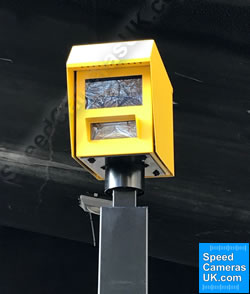
 SpeedCurb is a fixed roadside speed camera most easily recognised by its height - it is typically the tallest pole-mounted speed camera you will encounter on UK roads. Like the Gatso, SpeedCurb is rear-facing, capturing photographs of the back of a vehicle. However, where the Gatso uses radar to detect speeding, SpeedCurb relies on piezo sensors embedded in the road surface - the same detection method used by Truvelo and DS2 cameras. This means SpeedCurb cannot be detected by a radar detector.
SpeedCurb cameras are most commonly deployed on urban roads, with over a third of all SpeedCurb cameras in our database located in Greater London. Two thirds enforce 30mph speed limits. SpeedCurb can also be configured to enforce red light offences at junctions, making it a dual-purpose enforcement tool at some sites.
Most SpeedCurb sites are single-camera installations monitoring one lane. However, twin-head units mounted on a single pole can, when positioned on a central reservation, monitor up to four lanes of traffic simultaneously - two in each direction. All SpeedCurb cameras are fully digital with no film to retrieve.
How does a SpeedCurb camera work?
 SpeedCurb cameras use three piezo sensors embedded in the road surface, spaced one metre apart. As a vehicle drives over the sensors, the elapsed time between each sensor is recorded across three measurement intervals: sensors 1 to 2, sensors 2 to 3, and sensors 1 to 3. If the speed calculated from these time differences exceeds the enforcement threshold - for example 33mph in a 30mph zone - the SpeedCurb camera is automatically triggered.
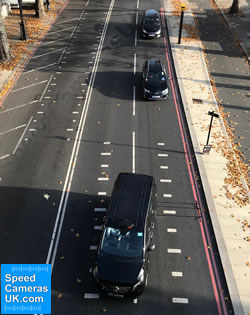
When triggered, the camera takes a total of three digital photographs. The first two are wide-angle images that show the vehicle, its make and model, and the surrounding environment. The third is a close-up of the vehicle's number plate. Together these three images provide a comprehensive photographic record of the offence. Because SpeedCurb is rear-facing, it photographs the back of the vehicle - not the driver's face. The image on the left shows check markings on the road surface adjacent to a SpeedCurb site, which are used for secondary speed verification.
SpeedCurb cameras are fully digital and always active. There is no film to run out and no limit to the number of vehicles the system can record. All images are transmitted electronically for processing. Do you have a question about SpeedCurb speed cameras? You can read UK motorists' SpeedCurb questions and answers and also submit your own unanswered question via our online form.
Secondary speed check: road surface markings
In addition to the piezo sensor readings, SpeedCurb uses check marks painted on the road surface to provide a secondary confirmation of vehicle speed. This secondary measurement is required by UK law for unmanned speed enforcement devices. By examining the position of the vehicle in the two wide-angle photographs against the painted check marks, enforcement officers can independently confirm the speed recorded by the sensors.
This is similar in principle to the white lines painted near Gatso cameras, which serve the same secondary verification purpose under the same legal requirement.
SpeedCurb vs Gatso: what is the difference?
SpeedCurb and Gatso are both rear-facing fixed speed cameras, but they use quite different detection technology and look very different at the roadside.
| Feature | SpeedCurb | Gatso |
|---|---|---|
| Facing direction | Rear-facing | Rear-facing |
| Pole height | Tall pole - distinctive height | Standard roadside pole |
| Detection method | Piezo sensors in the road | Radar |
| Number of photos | 3 (two wide-angle + one number plate close-up) | 2 |
| Road markings | Yes - check marks on road surface | Yes - white lines on road surface |
| Red light enforcement | Yes - at some sites | No |
| Detectable by radar detectors | No (no radar emission) | Yes |
Both camera types issue the same standard penalty: a £100 fine and 3 penalty points.
Where are SpeedCurb cameras used?
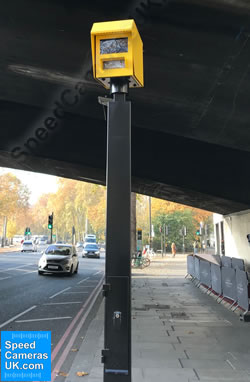 SpeedCurb cameras are predominantly found on urban roads, with a particularly high concentration in Greater London. Greater London accounts for over a third of all SpeedCurb cameras in the UK - around 25 of the 76 in our database - reflecting their strong association with Transport for London (TfL)-managed roads. Despite its distinctive tall pole mounting, SpeedCurb is a common sight on London roads and other urban areas where Safety Camera Partnerships have chosen the piezo-sensor approach over radar-based alternatives.
Two thirds of SpeedCurb cameras in our database enforce 30mph limits, which is consistent with their predominantly urban and suburban deployment. Unlike motorway cameras such as HADECS 3, SpeedCurb is rarely found on major trunk roads or motorways. Its typical habitat is the busy urban road, controlled junction, or bus lane where lower speed limits and high traffic volumes call for unobtrusive, always-active enforcement.
Want to know where the UK's SpeedCurb speed cameras are located before you drive? Our UK speed camera location database covers SpeedCurb sites and thousands of other fixed camera locations. The database also includes Gatso, Truvelo, Truvelo D-Cam, SPECS, Peek, Traffic Light cameras and more. Read about all speed camera types.
Penalties for SpeedCurb speed camera offences
If you are caught speeding by a SpeedCurb camera in the UK, you may receive:
- £100 fixed penalty fine
- 3 penalty points added to your driving licence
- An offer to attend a speed awareness course in some cases, as an alternative to points
Depending on the road's speed limit and your recorded speed, a court summons may be issued instead of a fixed penalty notice. This would arrive alongside a Notice of Intended Prosecution (NIP) with the relevant code - SP10, SP20, SP30, SP40 or SP50. For more information read our speeding fines guide. For official UK government guidance visit GOV.UK speeding penalties.