
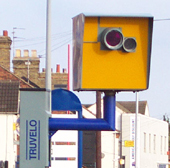
 The Truvelo is a forward-facing fixed speed camera and one of the key alternatives to the more common Gatso on UK roads. Its main advantage is that photographs are taken of the front of a passing vehicle, meaning the driver's face is clearly visible in any image captured as evidence of a speeding offence.
Truvelo cameras use piezo sensors embedded in the road surface rather than radar, and an infra-red flash rather than the bright white flash of a Gatso. Drivers caught speeding by a Truvelo receive the same standard penalty: a £100 fine and 3 penalty points.
Certain counties across England have long favoured the Truvelo over the Gatso, particularly Northamptonshire and Hampshire. More recently, Norfolk has been replacing a number of older cameras with the newer Truvelo D-Cam.
What is a Truvelo speed camera?
A Truvelo speed camera is a fixed roadside speed enforcement device that faces oncoming traffic, unlike the rear-facing Gatso. Because it photographs the front of a vehicle, it captures both the number plate and the driver, providing stronger evidence than a rear-facing camera. Truvelo cameras are typically painted yellow and housed in a distinctive grey or yellow roadside cabinet.
A newer digital version is now being installed at various locations throughout the UK. Click here to read more about the Truvelo D-Cam.
How does a Truvelo speed camera work?
The Truvelo camera uses piezo sensors to calculate a passing vehicle's speed. A total of four piezo sensors are embedded into the road surface. As a vehicle drives over them, the time difference between sensors is measured and used to calculate the vehicle's speed.
In addition there are three white painted lines on the road just before the camera. When the Truvelo speed camera is triggered, a photo using an infra-red flash is taken of the offending vehicle. The photo is taken when the vehicle is on the central white line; the other two lines represent +/-10%. This acts as a secondary method to calculate the vehicle's speed and is a legal requirement for unmanned speed enforcement devices in the UK.
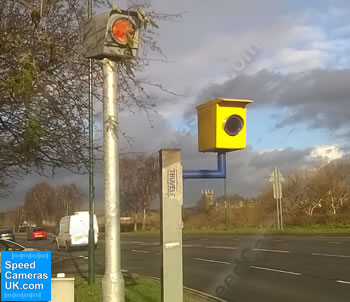
Pictured below: a Truvelo camera with a separate infra-red flash mounted on a pole. The majority of Truvelo cameras across the UK feature a built-in infra-red flash (as with the example pictured above right). However, a growing number now have a separately mounted orange-looking unit, required to illuminate the scene when the camera is triggered.
Do you have a question about Truvelo speed cameras? You can read UK motorists' Truvelo questions and answers and also ask your own unanswered question via our online form. Alternatively, read UK drivers' Truvelo camera comments.
What do the white lines on the road mean?
The three white lines painted on the road surface near a Truvelo camera serve as a secondary speed verification system. This is a legal requirement under UK law for all unmanned speed enforcement devices; the piezo sensor reading alone is not sufficient evidence.
When an image is taken, enforcement officers can calculate how far the vehicle has travelled between the camera trigger point and the central line, cross-referencing this with the primary sensor reading. The spacing of the lines is calibrated so that the distance travelled is proportional to speed, making any dispute over the recorded figure very difficult to sustain.
Does a Truvelo speed camera flash?
The Truvelo speed camera does not flash in the same way as a Gatso speed camera. Instead, Truvelo safety cameras use an infra-red flash which produces a much subtler light, barely perceptible to the human eye in daylight. This allows a clear photograph to be taken of the driver without dazzling them. The infra-red unit is provided either built into the camera housing or via a separately mounted orange-coloured unit.
Truvelo vs Gatso: what is the difference?
The most fundamental difference between a Truvelo and a Gatso is the direction the camera faces. A Gatso is always rear-facing, capturing the back of a speeding vehicle and its number plate. A Truvelo faces oncoming traffic, photographing the front of the vehicle and the driver.
Gatso cameras use radar technology to trigger the camera, while Truvelo cameras use piezo sensors in the road. The Gatso uses a bright white flash, which is why it faces away from traffic - to avoid dazzling drivers. The Truvelo uses a much softer infra-red flash precisely because it faces oncoming vehicles. If you see a speed camera facing towards you, it is almost certainly a Truvelo or Truvelo D-Cam, not a Gatso.
| Feature | Truvelo | Gatso |
|---|---|---|
| Facing direction | Forward-facing | Rear-facing |
| Detection technology | Piezoelectric sensors in the road | Radar |
| Flash | Infra-red (not visible in daylight) | Yes - bright visible flash |
| Captures driver's face | Yes (front of vehicle) | No (rear of vehicle) |
| Detectable by radar detectors | No (no radar emission) | Yes |
Caught by a Truvelo speed camera
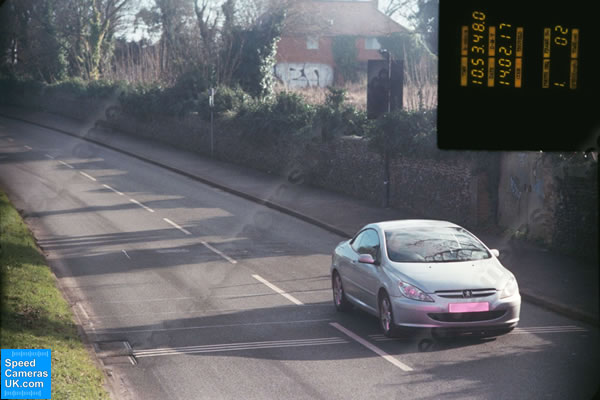
The photograph below depicts a motorist caught by a forward-facing Truvelo speed camera. Because the Truvelo photographs the front of the vehicle, the driver's face should be visible in the image - though factors such as sunlight, glare, or windscreen reflection can sometimes obscure it.
How common are Truvelo speed cameras in the UK?
Truvelo speed cameras are less common than Gatso speed cameras nationally. However, individual counties do favour their use. Northamptonshire and Hampshire have a notably high concentration of Truvelo cameras relative to other areas of England. Norfolk has also been actively replacing older Gatso cameras with the newer Truvelo D-Cam.
New Truvelo speed cameras: the Truvelo D-Cam
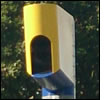 A newer version of the forward-facing Truvelo speed camera is being installed at various locations throughout the UK. These new cameras look very different to the traditional Truvelo and are significantly more advanced in their digital capabilities.
The new model is named the Truvelo D-Cam. Like its predecessor it is forward-facing, uses infra-red illumination and captures driver images, but it adds fully digital processing - eliminating any reliance on film or manual retrieval of images. This makes D-Cam cameras effectively always active, since there is no film to run out.
Truvelo speed camera locations
What is your view and experience with Truvelo speed cameras in the UK? Tell us and read more Truvelo comments. Alternatively, if you have a question relating to Truvelo fixed speed cameras, please see our Truvelo Q&A page.
Want to know where the UK's Truvelo speed cameras are as you drive? Here at SpeedCamerasUK.com we have a UK speed camera location database covering thousands of fixed camera sites. This database also includes Gatso, SpeedCurb, SPECS, Peek, Traffic Light speed cameras and more. Read more about all speed camera types.
Search Truvelo camera locations in our database →
Penalties for Truvelo speed camera offences
If you are caught speeding by a Truvelo camera in the UK, you may receive:
- £100 fine
- 3 penalty points on your driving licence
- An offer to attend a speed awareness course (in some cases, in lieu of points)
Depending on the road's speed limit and your recorded speed, a court summons may be issued instead of a fixed penalty notice. This would arrive alongside a Notice of Intended Prosecution (NIP) with the relevant code - SP10, SP20, SP30, SP40 or SP50. For more information on speeding penalties read our speeding fines guide. For official UK government guidance visit GOV.UK speeding penalties.