Truvelo and Truvelo D-Cam Speed Camera Questions and Answers
Answers to the most common questions UK motorists ask about Truvelo and Truvelo D-Cam speed cameras - covering their forward-facing operation, how piezo road sensors work, the difference between the two camera types, whether they can catch motorcycles, and what to do if you receive a Notice of Intended Prosecution.
SpeedCamerasUK.com does not operate any UK speed cameras and has no connection to UK Government, the Police, or any Safety Camera Partnership. We are unable to advise on individual speeding cases or the progress of a speeding offence. If you have a question not answered below, please use our contact form.
How Truvelo cameras work
Is the Truvelo a forward-facing or rear-facing camera?
Truvelo speed cameras are forward-facing. They photograph the front of an approaching vehicle, including the front number plate and the driver's face. This is one of the key differences between the Truvelo and the rear-facing Gatso. Because the camera faces oncoming traffic, it can only capture vehicles driving towards it.
Can a Truvelo camera catch me if I am driving away from it or on the opposite side of the road?
The original Truvelo can only capture vehicles driving directly towards its lens. If you were driving away from it or on the opposite carriageway, it cannot record your speed or number plate. White lines are sometimes painted on both sides of the road to allow the camera to be periodically turned to enforce traffic in the opposite direction, or as a deterrent to slow vehicles in both directions.
Does a Truvelo camera photograph the driver?
Yes. This is a distinctive feature of both the Truvelo and Truvelo D-Cam. Because the camera is forward-facing, it captures a photograph of the driver at the time of the offence, as well as the front number plate. This is one reason some Police forces favour Truvelo cameras - there is no dispute about who was driving.
How do the piezo sensors in the road work?
Truvelo cameras use thin piezo strips embedded in the road surface, positioned a few metres in front of the camera. When a vehicle passes over these strips above the speed threshold, the camera is triggered to take two photographs. The white road markings provide a secondary speed check, confirming the vehicle's position between the two images. The piezo strips on each side of the road are not always the same distance apart - each camera has its own calibration certificate recording the exact measurements, which can be requested from the relevant Police force.
Can a Truvelo camera catch both directions of traffic simultaneously?
No. A single Truvelo can only cover one direction of traffic at a time. It can be calibrated and physically turned to enforce the opposite direction, but it cannot target both directions at once.
Are all Truvelo cameras active, or are some dummies?
Not all Truvelo cameras are necessarily in working order at any given time - some may be switched off or awaiting maintenance. The only people who know for certain whether a specific camera is active are the camera installer and the responsible Police authority. Do not assume a camera is inactive.
The Truvelo D-Cam
What is the difference between a Truvelo and a Truvelo D-Cam?
The Truvelo D-Cam is the digital successor to the original Truvelo. Both are forward-facing and use piezo road sensors, but the D-Cam is a fully digital system that stores images electronically rather than on film. A key additional capability of the D-Cam is that it can be configured to target vehicles travelling in either direction, unlike the original Truvelo which is strictly forward-facing. The D-Cam also operates 24 hours a day using infra-red technology.
Can a Truvelo D-Cam catch me from behind?
Unlike the original Truvelo, the D-Cam can be configured to capture vehicles travelling in either direction. If you were driving away from a D-Cam that had been set up to target vehicles in your direction, it is possible your speed was recorded. If you receive a NIP you were not expecting, contact the issuing Police force and ask for the photographic evidence.
How quickly are Truvelo D-Cam images sent to the Police?
For older wet-film Truvelo cameras, a camera operator must visit the location, collect the film, and have it developed before the images can be processed. For digital Truvelo D-Cam cameras, images may be wirelessly transmitted to a control room, though in many cases an operator will still need to visit the site and connect to download them. Processing times vary between Police forces and camera operators.
Flashing and triggering
Does a Truvelo camera flash visibly?
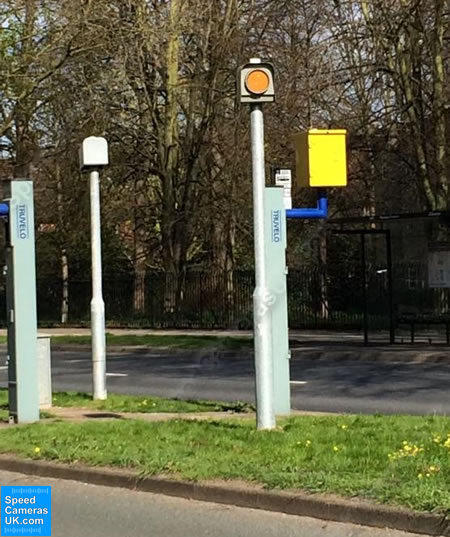
Truvelo cameras are designed to use infra-red flash technology, which is not visible to the human eye. However, at a number of Truvelo locations, orange flash units have been added on separate poles alongside the camera to improve the quality of photographs, particularly at night. These do emit a visible flash. Motorists have also reported seeing a flash at some infra-red Truvelo sites, suggesting the flash is not always as invisible as intended.
I was in a queue of traffic when the camera flashed at the vehicle in front - could I receive their ticket?
No. Truvelo cameras use two methods to identify the speeding vehicle: the piezo sensors in the road trigger the camera, and the photographs show the vehicle's position relative to the white road markings. If another vehicle triggered the camera, the photographic evidence would identify that vehicle, not yours. The images would show which vehicle crossed the sensor strips above the speed threshold.
What are the orange poles appearing beside some Truvelo cameras?
The grey and orange units on poles appearing next to some Truvelo camera sites are infra-red flash units. They are being added at a number of locations across the UK to improve the brightness and quality of photographs, particularly in low-light conditions and at night.
Motorcycles, NIPs, and prosecution
Can a Truvelo camera catch a motorcyclist?
No, not directly. Both the original Truvelo and the Truvelo D-Cam are forward-facing and photograph the front number plate of approaching vehicles. Motorcycles in the UK are not required to display a front number plate, so a Truvelo cannot record a motorcycle's registration. This applies to all forward-facing speed cameras.
What is the speed threshold at which a Truvelo issues a NIP?
The prosecution threshold is set by the local Police force, not by the camera itself. ACPO guidelines suggest speed limit plus 10% plus 2mph, but some forces use a lower threshold - Truvelo cameras have been reported to trigger at 33mph in a 30mph zone in some areas. The specific figure is only known by the camera operator and relevant Police authority.
How long do I have before I receive a Notice of Intended Prosecution?
A Notice of Intended Prosecution must be sent to the registered keeper of the vehicle within 14 days of the alleged offence. If you do not receive one within that period, the prosecution may not be able to proceed, though exceptions exist. Our NIP guide covers the process in full.
Got a Truvelo question not answered above? Use our contact form to send it to us. Please note we cannot provide legal advice or comment on individual speeding cases.
Disclaimer: Answers published on SpeedCamerasUK.com represent the views of the site and its contributors. SpeedCamerasUK.com is not connected to any UK Police force, local authority, or Safety Camera Partnership.


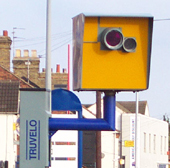 Answers to the most common questions UK motorists ask about Truvelo and Truvelo D-Cam speed cameras - covering their forward-facing operation, how piezo road sensors work, the difference between the two camera types, whether they can catch motorcycles, and what to do if you receive a Notice of Intended Prosecution.
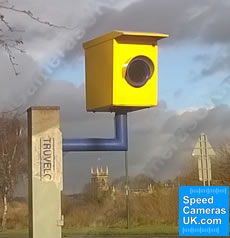 Truvelo speed cameras are forward-facing. They photograph the front of an approaching vehicle, including the front number plate and the driver's face. This is one of the key differences between the Truvelo and the rear-facing
 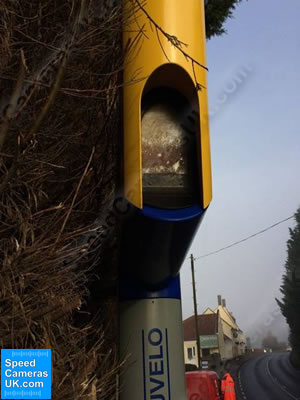 The Truvelo D-Cam is the digital successor to the original Truvelo. Both are forward-facing and use piezo road sensors, but the D-Cam is a fully digital system that stores images electronically rather than on film. A key additional capability of the D-Cam is that it can be configured to target vehicles travelling in either direction, unlike the original Truvelo which is strictly forward-facing. The D-Cam also operates 24 hours a day using infra-red technology.
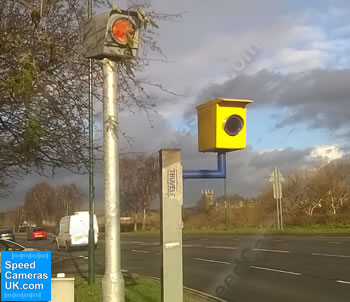 Truvelo cameras are designed to use infra-red flash technology, which is not visible to the human eye. However, at a number of Truvelo locations, orange flash units have been added on separate poles alongside the camera to improve the quality of photographs, particularly at night. These do emit a visible flash. Motorists have also reported seeing a flash at some infra-red Truvelo sites, suggesting the flash is not always as invisible as intended.
 No, not directly. Both the original Truvelo and the Truvelo D-Cam are forward-facing and photograph the front number plate of approaching vehicles. Motorcycles in the UK are not required to display a front number plate, so a Truvelo cannot record a motorcycle's registration. This applies to all forward-facing speed cameras.