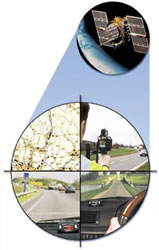
 A sat nav with speed camera alerts combines full turn-by-turn navigation with a built-in database of speed camera locations. As you approach a recorded camera site, the device gives you both a visual and audible warning - giving you time to check your speed before you reach it.
This guide covers how sat nav speed camera alerts work, which types of sat nav are available for different vehicle types, and what to look for when buying. SpeedCamerasUK.com has been tracking UK speed camera locations since 2000.
How sat nav speed camera alerts work
Speed camera alerts on a sat nav are driven by a Points of Interest (POI) database - a set of GPS co-ordinates that correspond to recorded speed camera locations across the UK and, in many cases, Europe. The database is stored on the device itself rather than retrieved in real time over a data connection.
As your vehicle approaches one of these recorded co-ordinates, the device detects that you are within the alert distance and triggers a warning. The screen displays information about the camera - typically the camera type, the posted speed limit for that road, and your current speed. An audible tone or voice prompt also sounds. The distance at which the alert fires can usually be adjusted in the device settings.
Because this approach relies entirely on GPS position rather than signal detection, sat navs can alert you to every type of fixed camera, including average speed camera zones such as SPECS and VECTOR. These systems use number plate recognition between two fixed points and emit no radar or laser signal. A radar detector cannot warn you of average speed cameras at all, but a GPS database can.
There are two database models in current use. A static database is updated periodically - you connect the sat nav to your computer or a Wi-Fi network and download the latest data from the manufacturer's server. Most current Garmin models include free lifetime speed camera and map updates as standard, so there is no ongoing subscription cost. A live database, used by some dedicated GPS detectors, delivers updates in real time over a mobile data connection, which is particularly useful for newly deployed mobile camera sites. Most sat navs use the static model rather than live updates.
Car sat navs
For most drivers, a car sat nav is the standard choice. It mounts to the windscreen using a suction-cup bracket, draws power from the vehicle's cigarette lighter socket, and provides navigation covering UK and European roads alongside speed camera warnings.
Current Garmin models display the speed limit continuously on screen throughout your journey - not only when you are approaching a camera location. This means the device acts as a constant speed limit reminder regardless of whether a camera is nearby, which is particularly useful on unfamiliar roads where limits change frequently.
Speed camera database updates on current Garmin car sat navs are included free for the lifetime of the device, delivered via the Garmin Express application on your computer or directly via Wi-Fi on compatible models. There is no annual renewal cost for the camera database.
View car sat navs at ActiveGPS.co.uk
Truck and van sat navs
HGV and commercial vehicle drivers have routing and speed limit requirements that a standard car sat nav does not address. Speed limits for large vehicles differ from those for cars - they vary by road type and by the weight of the vehicle - and routing must avoid low bridges, weight-restricted roads, and roads that are physically unsuitable for large vehicles. A car sat nav ignores all of this and may direct an HGV driver down a route that is unsafe or legally non-compliant.
The Garmin dezl range is designed specifically for HGV and commercial vehicle drivers. You enter your vehicle's height, weight and length, and the device routes accordingly - filtering out restrictions that would be a problem for your specific vehicle. Speed camera alerts are included alongside the HGV-appropriate routing and speed limit data.
Van drivers whose vehicles fall below HGV weight thresholds may find a standard car sat nav is adequate, but drivers of larger vans or those towing heavy trailers should consider whether truck-specific routing is the right choice for their use.
View truck and van sat navs at ActiveGPS.co.uk
Motorhome and caravan sat navs
Motorhomes and caravans present the same fundamental routing problem as large commercial vehicles. Standard car navigation will direct a motorhome down a narrow lane or towards a bridge with insufficient clearance without any warning. With a large motorhome or a towed caravan, this is not merely inconvenient - getting stuck on an unsuitable road or wedged under a low bridge can cause serious damage.
The Garmin Camper range is built for leisure vehicle drivers. You enter the dimensions of your vehicle - including the length and weight of a towed caravan or trailer - and the device routes around obstacles that would be hazardous for your outfit. Speed camera alerts are built in as standard. The device also accounts for the fact that speed limits differ when towing: in the UK, the limit when towing on a dual carriageway is 60mph rather than the standard 70mph for cars alone.
If you regularly travel to European touring parks and campsites, the Garmin Camper range includes European map coverage, so the same device works across the Channel.
View motorhome and caravan sat navs at ActiveGPS.co.uk
Motorcycle sat navs
A standard car sat nav is impractical on a motorbike. A motorcycle sat nav needs to be fully weatherproof, readable in direct sunlight, operable with gloved hands, and designed for secure handlebar mounting. Audio alerts from the device's own speaker are of limited use on a bike - a Bluetooth connection to a compatible helmet audio system allows the sat nav to deliver voice prompts and camera warnings directly to the rider, with no need to remove hands from the bars.
The Garmin zumo range is built to these requirements. It is fully weatherproof, has a glove-friendly touchscreen, and includes Bluetooth connectivity for compatible helmet systems. Speed camera alerts are supported across the range. Models are available to suit both daily commuting and longer touring use.
Speed camera awareness is particularly relevant for motorcyclists. The legal consequences of a prosecution are the same as for a car driver - penalty points, insurance increases, and potential disqualification for those already carrying points - but the financial and practical impact of losing a licence can be considerable for a motorcyclist who depends on it.
View motorcycle sat navs at ActiveGPS.co.uk
Features to look for when buying
Screen size is worth considering at the outset. A larger screen is easier to read at a glance while driving. How the screen performs in direct sunlight matters equally - some displays wash out badly in bright conditions and become difficult to use in summer or on south-facing routes. A matte anti-glare screen performs significantly better in high-light conditions.
Check whether the speed camera database subscription is included free for the lifetime of the device or whether it requires a paid annual renewal. Most current Garmin models include free lifetime updates, removing any ongoing cost. Some devices from other manufacturers require a subscription after the first year. The frequency of updates is also relevant - a database refreshed monthly is more likely to reflect newly installed cameras than one updated every six months.
Consider whether the device shows the speed limit continuously on all roads or only at camera locations. A device that displays the limit at all times is more useful day-to-day, particularly on roads where limits change frequently such as urban A-roads and roads through villages.
Map coverage is a practical consideration if you drive in Europe. Confirm that the device includes European maps and that speed camera data is provided for the countries you intend to visit. UK-only coverage is standard on some budget models.
Live traffic updates allow the device to reroute around congestion in real time. This is a separate feature from speed camera updates - check whether the device includes live traffic as standard, or whether it requires an additional subscription or a paired smartphone connection via Bluetooth.
Bluetooth connectivity enables pairing with a smartphone for hands-free calls and, on motorcycle models, for audio output to a compatible helmet. Voice control allows you to enter destinations or adjust settings without lifting your hands from the wheel. Both are useful if you spend significant time in the vehicle.
Consider how the device will mount in your specific vehicle. Most car sat navs use a windscreen suction cup, which works well in most cars. Some vehicles - particularly those with heat-reflective or tinted windscreens - do not retain suction mounts reliably, and a dashboard friction mount may be more stable for everyday use.
One important limitation applies to all GPS-based sat navs: the device cannot tell you whether a fixed camera is actually switched on. It records only that a camera is known to be at that location. A Gatso camera that has been decommissioned or is temporarily out of service will still appear in the database. Only a radar detector can indicate whether a Gatso is actively operating - and only at the moment it emits a radar pulse. For all other camera types, which emit no detectable signal, neither a sat nav nor a radar detector can confirm whether the camera is operational.
For the current range of sat navs with speed camera alerts, visit ActiveGPS.co.uk.
Last updated: May 2026.