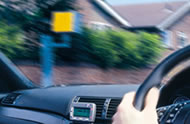
 Most speed camera detectors and sat navs are straightforward to fit and require no tools or vehicle modification. The majority mount to the windscreen with a suction cup and power from the cigarette lighter socket. There are a few things worth knowing before you start, particularly if your vehicle has a heat reflective windscreen or you plan to use the device on a motorcycle.
This guide covers the main installation methods, the most common problem drivers encounter - heat reflective glass blocking GPS signals - and the options for hardwiring and motorcycle use.
Windscreen mounting
The majority of speed camera detectors and sat navs mount to the windscreen using a suction cup bracket supplied with the device. The suction cup presses against the glass and a lever locks it in place, creating a secure hold that can be removed and repositioned without leaving marks.
Position the device within your natural field of view - somewhere you can glance at the screen without significantly moving your eyes from the road - but without obstructing your sightlines. The device must not be placed in a position that blocks your view of the road ahead, pedestrians or other vehicles.
By law, the device must be mounted outside the area swept by the windscreen wipers. Placing a device within the wiper sweep area is not permitted. The most common and legally safest placement is low and central, near the bottom of the windscreen, just behind the rear-view mirror. This keeps the device within your field of view while remaining outside the wiper zone and well away from the area you look through when driving.
The power cable runs from the device down to the cigarette lighter socket. Route the cable neatly around the edge of the windscreen frame and along the door sill or dashboard edge rather than leaving it trailing across the dashboard or footwell. Most devices come with a cable long enough to allow a tidy run to the socket without stretching.
Dash mounting
Some devices can alternatively be mounted on the dashboard using a friction or adhesive dash mount. This places the device lower than a windscreen mount and may be preferable in vehicles where windscreen mounting is not practical - for example where the windscreen angle makes suction cup adhesion unreliable, or where interior fittings leave little suitable glass area.
Friction mounts use a weighted base with a non-slip surface and grip the dashboard without any adhesive. They are easy to move between vehicles and leave no residue. Adhesive mounts use a bonding pad for a more secure and permanent fixing. Removing an adhesive mount can leave residue on the dashboard surface, and in some cases may mark softer plastics - worth bearing in mind before committing to this method.
Whether windscreen or dash mounted, the device must be positioned so it does not obstruct your view of the road. A dash-mounted device should sit within easy eyeline without requiring you to look down steeply or away from the traffic ahead.
Heat reflective windscreens
This is the most important installation issue to be aware of, and the one most likely to cause problems if you are not expecting it. Some vehicles are fitted with heat reflective or solar-reflective windscreens, sometimes described by manufacturers as Comfort Glass or Thermally Insulated Glass. These windscreens contain a very thin metallic coating bonded into the glass that reflects infrared radiation, reducing the amount of heat entering the cabin and helping keep interior temperatures lower on sunny days.
The same metallic coating that reflects infrared also blocks or significantly weakens GPS satellite signals. GPS signals travel at a similar frequency range to the infrared radiation the coating is designed to reflect. A GPS device mounted inside a heat reflective windscreen may struggle to acquire a satellite fix when first switched on, may take considerably longer than usual to lock onto satellites, or may lose its fix intermittently while driving - particularly on longer journeys or when the satellite geometry overhead is less favourable.
Vehicles commonly fitted with heat reflective windscreens include certain models from Renault, Citroen and Peugeot, as well as some models from other European manufacturers. The windscreen is usually identifiable by a slight blue or green tint visible when viewed at an angle, and most heat reflective windscreens carry a small printed logo in the corner of the glass - typically a sun symbol or the words "Comfort Glass" or "Solar Glass" - identifying them as thermally insulated.
It is worth noting that a standard heated windscreen - the type fitted to many modern vehicles that uses a network of fine heating filaments within the glass to clear frost and condensation - does not cause this problem. Heated windscreens and heat reflective windscreens are entirely different technologies. A heated windscreen has no metallic coating and does not affect GPS reception.
If your vehicle has a heat reflective windscreen, the solution is an external GPS antenna. This is a small passive antenna - roughly the size of a matchbox - that connects to the GPS device via a short cable. The antenna picks up the satellite signal directly, bypassing the heat reflective glass entirely. It can be positioned on the rear parcel shelf, on the dashboard near the edge of the windscreen where there may be a small area of uncoated glass, or on the exterior of the vehicle such as on the roof near the base of the windscreen. As long as the antenna has a clear view of the sky, it will maintain a reliable satellite fix regardless of what the windscreen is made from.
Not all GPS speed camera detectors and sat navs include an external antenna connection - it varies by model. If you know or suspect your vehicle has a heat reflective windscreen, check the specification of any device you are considering before buying to confirm it supports an external antenna input. Some manufacturers sell the antenna as an optional accessory rather than including it in the box.
Hardwiring and power
For the vast majority of GPS speed camera detectors, the cigarette lighter socket is the right power solution. The supplied cable plugs into the socket, the device powers on automatically when the ignition is switched on, and powers off when you turn the engine off. No modification to the vehicle is needed, and if you want to move the device to another car you can simply unplug it and take it with you.
Some GPS detectors also include an internal battery that allows the device to run for a few hours without being connected to the cigarette lighter socket. This is useful if you want to use the device outside the car briefly, or if your vehicle's cigarette lighter socket switches off with the ignition before you have finished parking.
Hardwiring to the vehicle's fusebox is generally only necessary for dash cams that need to operate in parking mode - continuing to record when the engine is switched off and the vehicle is unattended. Parking mode requires a permanent low-current power supply that stays live after the ignition is off. This is provided by connecting the dash cam to the fusebox via a fused hardwire kit, which draws power from a circuit that remains active when the engine is not running.
Hardwiring is a straightforward job for anyone familiar with vehicle electrics, and most car audio and in-car technology fitting centres offer this as a standard paid service. If you are not confident working with vehicle wiring, having it done professionally is the sensible option - a poorly fused connection can drain the battery or, in the worst case, cause an electrical fault.
GPS speed camera detectors do not typically require or benefit from hardwiring. Parking mode is a dash cam feature, not a speed camera detector feature. If you have a combined GPS detector and dash cam such as the Snooper MY-SPEED DVR PLUS, the parking mode consideration applies to the dash cam function specifically.
Motorcycle installation
Standard windscreen-mounted speed camera detectors and sat navs are not suitable for motorcycle use. They are not weatherproof, cannot be safely or securely mounted on handlebars or fairings, and their touchscreens are not designed to be operated with motorcycle gloves.
Dedicated motorcycle sat navs such as the Garmin zumo range are built specifically for this environment. They are fully weatherproof to a standard that allows use in rain and at motorway speeds, use a glove-friendly touchscreen that responds reliably through motorcycle gloves, and mount to the handlebars via a secure locking cradle that holds the device firmly even on rough roads or spirited riding. Power is taken from the motorcycle's electrical system via the cradle, which also protects the charging connection from water ingress.
Audio alerts and turn-by-turn navigation prompts can be delivered via Bluetooth to a compatible helmet headset, so the rider receives warnings through their helmet speakers without needing to look at the screen. The Garmin zumo range includes a speed camera database covering fixed and mobile camera locations across the UK and Europe, alerting the rider as they approach recorded sites.
Read the sat nav buying guide
View motorcycle sat navs at ActiveGPS.co.uk
Last updated: May 2026.